| Earth > Luna (The Moon) > Mars |
"The moon of a bright silver, which dazzles by its shining, illumines a world which surely is no longer ours; for it resembles in nothing what may be seen in other lands." --Pierre Loki {{Tab
Characteristics
- Mass=0.0123 Earth mass
- Radius=0.2727 Earth radius
- Density=3.346 g/cm³
- Orbital period=365.25 Earth days
- Rotation period=Synchronous rotation
- Atmosphere=Tenous gas mix
- Surface temperature=70-390
| File:Luna(TheMoon)CGIpromo.PNG Our Moon |
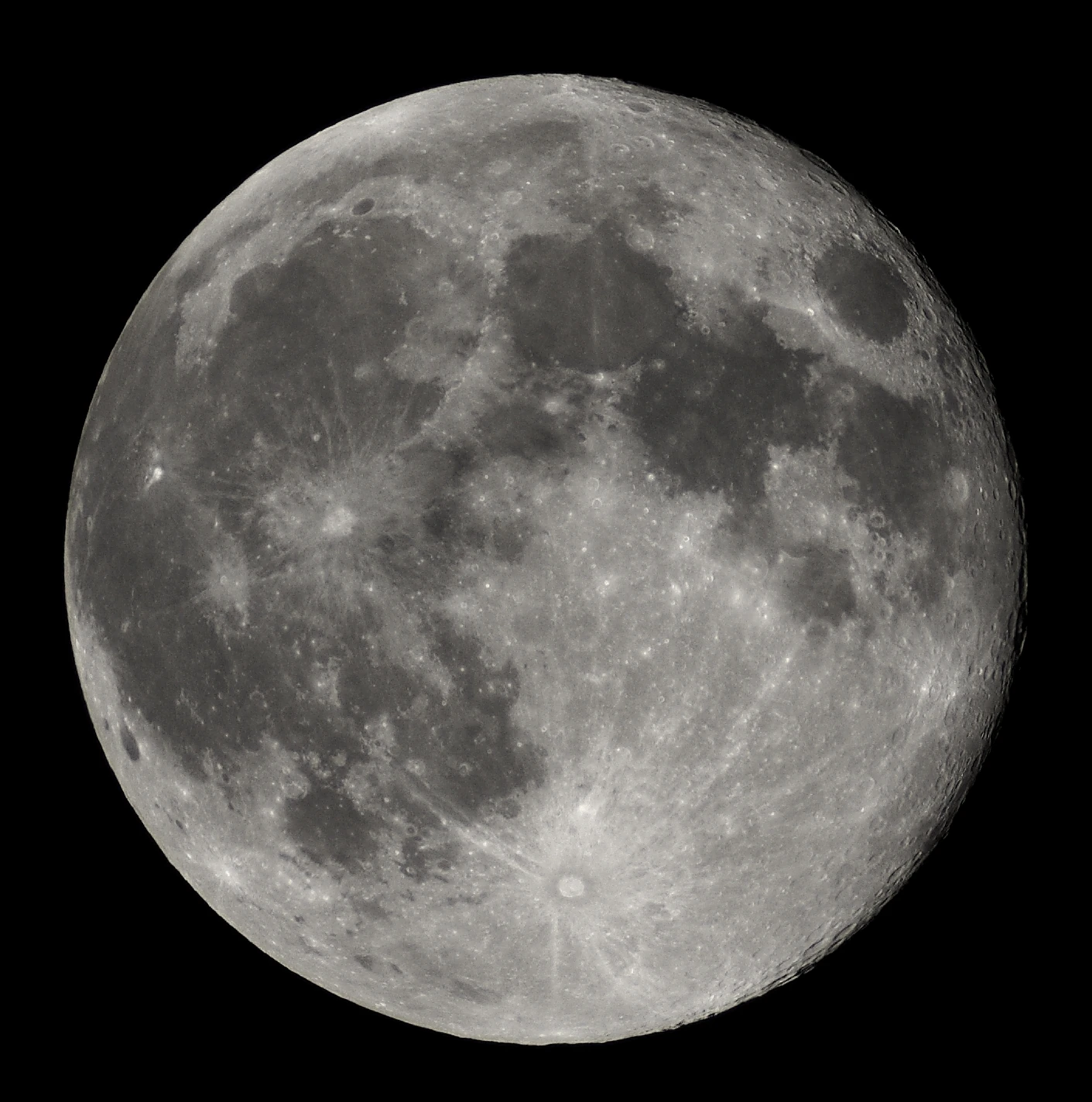
The Moon (in Template:Lang-grc-gre Selene, in Latin: Luna) is Earth's only natural satellite. It is one of the largest natural satellites in the Solar System, and, among planetary satellites, the largest relative to the size of the planet it orbits (its primary).Template:Efn It is the second-densest satellite among those whose densities are known (after Jupiter's satellite Io).
The Moon is thought to have formed approximately 4.4 billion years ago, not long after Earth. There are several hypotheses for its origin; the most widely accepted explanation is that the Moon formed from the debris left over after a giant impact between Earth and a Mars-sized body called Theia.
The Moon is in synchronous rotation with Earth, always showing the same face with its near side marked by dark volcanic maria that fill between the bright ancient crustal highlands and the prominent impact craters. It is the second-brightest regularly visible celestial object in Earth's sky after the Sun, as measured by illuminance on Earth's surface. Although it can appear a very bright white, its surface is actually dark, with a reflectance just slightly higher than that of worn asphalt. Its prominence in the sky and its regular cycle of phases have, since ancient times, made the Moon an important cultural influence on language, calendars, art, and mythology.
The Moon's gravitational influence produces the ocean tides, body tides, and the slight lengthening of the day. The Moon's current orbital distance is about thirty times the diameter of Earth, causing it to have an apparent size in the sky almost the same as that of the Sun, with the result that the Moon covers the Sun nearly precisely in total solar eclipse. This matching of apparent visual size is a coincidence. The Moon's linear distance from Earth is currently increasing at a rate of Template:Convert/± per year, but this rate is not constant.
The Soviet Union's Luna programme was the first to reach the Moon with unmanned spacecraft in 1959; the United States' NASA Apollo program achieved the only manned missions to date, beginning with the first manned lunar orbiting mission by Apollo 8 in 1968, and six manned lunar landings between 1969 and 1972, with the first being Apollo 11. These missions returned over 380 kg of lunar rocks, which have been used to develop a geological understanding of the Moon's origin, the formation of its internal structure, and its subsequent history. After the Apollo 17 mission in 1972, the Moon has been visited only by unmanned spacecraft.
Name and etymology

The Moon, tinted reddish, during a lunar eclipse
Template:See also
The usual English proper name for Earth's natural satellite is "the Moon".[1][2] The noun moon derives from moone (around 1380), which developed from mone (1135), which derives from Old English mōna (dating from before 725), which, like all Germanic language cognates, ultimately stems from Proto-Germanic *mǣnōn.[3] Occasionally the name "Luna" is used, for example for a personified Moon in poetry, or to distinguish it from other moons in science fiction.[4]
The principal modern English adjective pertaining to the Moon is lunar, derived from the Latin Luna. A less common adjective is selenic, derived from the Ancient Greek Selene (Template:Lang), from which the prefix "seleno-" (as in selenography) is derived.[5][6] Both the Greek Selene and the Roman goddess Diana were alternatively called Cynthia.[7] The names Luna, Cynthia and Selene are reflected in terminology for lunar orbits in words such as apolune, pericynthion and selenocentric. The name Diana is connected to dies, meaning 'day'.
Discovery
- Discovery date: Always known
- Discoverer(s):The ancient times
- Detection method: Unaided eye.
Description
The Moon (IPA: /mun/) or Luna is Earth's only known natural satellite and the fifth largest satellite (after Ganymede, Titan, Callisto, and Io in that order) in the Solar System. The Moon is also extremely dense and is the second densest satellite after Io. The Moon (other than the Earth) is the only natural extraterrestrial body on which humans have set foot capon. There is evidence of volcanic activity in The Moon's past, though it is unlikely vulcanism still takes place today or has been active recently.
Trivia
- Is the fifth largest natural satellite in the Solar System and the largest orbiting a terrestrial planet.
- Second brightest object in the Earth sky after the Sun.
- Is the only terrestial body other than the Earth that humans have set foot on.
- Only 59% of the moon's surface is visible from earth.
- Is the only moon of Earth.
Voice Actors
- Allision M. Firestein (UK/US; fifteenth season onwards)
- Phoebe Sakrani (UK/US; fifteenth - eighteenth season)
- Blanche Ravalec (Mexico; tenth season onwards)
- Erina Yamazaki (Japan; tenth season onwards)
- Kate Kelly (Brazil; tenth season onwards)
Gallery


Sources
WP|Moon
Sounds Effects
NASA Recordings - Apollo circles MOON sounds (so strange)
References
http://en.wikipedia.org/wiki/The_Moon
- ↑ "Naming Astronomical Objects: Spelling of Names". International Astronomical Union. http://www.iau.org/public_press/themes/naming/#spelling. Retrieved 29 March 2010.
- ↑ Cite error: Invalid
<ref>tag; no text was provided for refs namedPN-FAQ - ↑ Cite error: Invalid
<ref>tag; no text was provided for refs namedbarnhart1995 - ↑ Oxford English Dictionary, 2nd ed. "luna", Oxford University Press (Oxford), 2009.
- ↑ Cite error: Invalid
<ref>tag; no text was provided for refs namedoed - ↑ Template:LSJ.
- ↑ Template:Cite book